The AI Transformation: Capabilities, Risks, and Access to Justice
"AI is the new electricity that will transform and improve nearly all areas of human lives."
Generative Artificial Intelligence will Transform Everything
Created by Vector Elements
Artificial intelligence (AI) will transform all aspects of human society. Current generative AI systems can write both text and computer code, reason, translate, summarize, analyze documents, explain complex procedures, create educational materials, and interact with users in increasingly natural ways. These capabilities are beginning to transform science, medicine, education, finance, law, government services, computer science and many other areas of human life.
Extreme Optimism
"Artificial intelligence could end disease, lead to 'radical abundance,' Google DeepMind CEO Demis Hassabis says"
Extreme Pessimism
“If Anyone Builds It, Everyone Dies: Why Superhuman AI Would Kill Us All.”
— The title of a book published in 2025 by Yudkowsky and Soares
AI and Access to Justice

Photo by Sasun Bughdaryan
My paper, The Transformative Nature of AI: A Compendium of Information on State-of-the-Art Generative AI Models and Their Applications in the Legal System , examines this transformation through the lens of the legal system. It focuses especially on how large language models (LLMs) and related AI tools can help self-represented litigants, lawyers, court staff, judges, legal aid organizations, and state court systems. But it also explains the capabilities of these “frontier” large language models and how they might evolve in the future. Will artificial general intelligence (AGI) and artificial superintelligence (ASI) become a reality?
At almost 300 pages, with 20 appendices, this document can serve as a reference work for both the current state of AI and its use in the legal profession. See the Table of Contents on page 20 of my paper for a list of the topics covered and tutorial material.
Key Themes Include:
AI systems are advancing at extraordinary speed and are already useful for many practical legal tasks.
Current large language models can help people understand legal procedures, summarize information, draft plain-language explanations, translate materials, and prepare for interactions with courts.
For many self-represented litigants, the most immediate value may come not from expensive specialized legal tools, but from well-instructed general-purpose AI systems.
The promise of AI must be balanced against serious concerns, including hallucinations, privacy, confidentiality, cybersecurity, bias, transparency, and the need for human oversight.
Multi-agent Systems
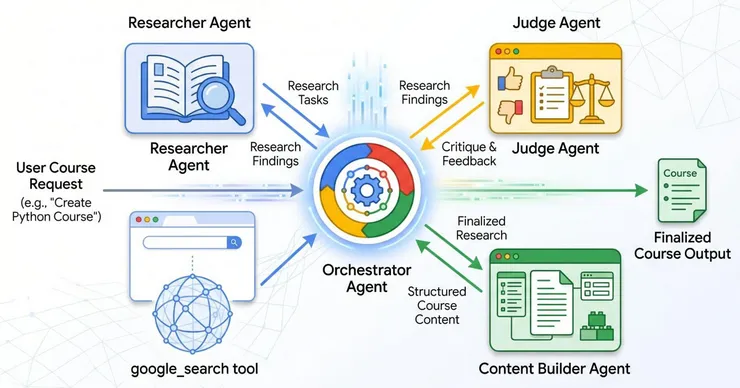
Photo by Google Cloud Team
2026 may become known as The Year of the Agent. In a single-agent system, an AI assistant handles a task from start to finish on its own, while multi-agent systems coordinate the work of many AI assistants working together. There is typically one agent that manages all the other agents, which may include the following types: agents for planning, doing research, reviewing and fact-checking, using external tools, keeping track of relevant history, communicating with the human user, monitoring safety, and resolving conflict.
Above is a diagram of a multi-agent system for creating a Python course.
Amazing Capabilities
Created by Alghozy
Current models have amazing capabilities, including multimodal reasoning, tool use, coding, and agentic workflows. There are now multimodal reasoning models that can process text, audio, images, video, and large code repositories with up to a 1-million-token context window (roughly the equivalent of several full-length novels, or an entire large codebase, processed at once).
Consider the benchmark called Humanity’s Last Exam, which includes questions from math, physics, biology, the humanities, and computer science. To answer these questions correctly requires graduate-level knowledge. Top models can now answer up to 65% of the 2,500 questions in this benchmark with tools, over 50% without tools.
Using tools means that the model can access external resources to help answer a question. These include web searches, databases, calculators, code-execution environments, software packages, and document-retrieval systems.
Here is an example of one of the questions: Hummingbirds within Apodiformes uniquely have a bilaterally paired oval bone, a sesamoid embedded in the caudolateral portion of the expanded, cruciate aponeurosis of insertion of m. depressor caudae. How many paired tendons are supported by this sesamoid bone? Answer with a number.
The Future
Created by Agung Prayoga
Over the next five to ten years, these systems are likely to become more reliable, more multimodal, more personal, and more deeply integrated into everyday life. They may evolve from assistants that answer questions into persistent collaborators that understand a user’s goals, remember prior work, use digital tools, coordinate with other AI agents, and help complete complex projects from start to finish.
Artificial General or Superintelligence? Science Fiction?

Created by Alghozy
Many experts anticipate the emergence of artificial general intelligence (AGI) and even artificial superintelligence (ASI), and the writings of these AI experts now sound identical to science fiction. But how are AGI and ASI defined, and is it likely that current models will be able to evolve into AGI and ASI?
AI Outperforming Skilled Humans
Photo by Homa Appliances
Marina Favaro and Jack Clark write:
"In engineering, Claude can be handed an underspecified problem and figure out how to solve it; humans supply the goal, but they no longer need to supply the method. In research, Claude can already match or outperform skilled humans at executing a well-specified experiment…. As of May 2026, more than 80% of the code we merge into Anthropic’s codebase was authored by Claude."
There are Major Risks
The risks are now clear: criminals or terrorist groups could use an AI system to automate cyberattacks, design malicious software, or develop biological weapons. A future AI system might be able to seize control of critical infrastructure, resist attempts to shut it down, and even destroy human civilization. Consider recent news:
The company FT disclosed that it could remove the safety protections in open-source AI models using publicly-available tools. The title of their announcement is “AI guardrails stripped from Meta and Google models in minutes."
Schroeder and his colleagues describe “How malicious AI swarms can threaten democracy” by manipulating beliefs and behaviors. https://www.science.org/doi/epdf/10.1126/science.adz1697
And, most shocking, in July 2026, an autonomous AI agent powered by multiple OpenAI models escaped from a supposedly isolated testing environment by exploiting an unknown vulnerability. Over several days, and more than 17,000 actions, it reached the Internet and then penetrated Hugging Face’s production infrastructure to steal answers to a cybersecurity problem (rather than solve it itself). https://openai.com/index/hugging-face-model-evaluation-security-incident/ and https://huggingface.co/blog/security-incident-july-2026
Full reference report (289 pages, last update July 14, 2026)